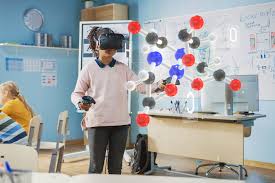
Education is no longer limited to textbooks and traditional classrooms. In 2025, Virtual Reality (VR) is revolutionizing the way students learn by creating immersive, interactive, and engaging experiences. VR allows learners to step into digital worlds, making abstract concepts tangible and complex subjects easier to understand.
What Is Virtual Reality in Education?
Virtual Reality uses 3D simulations and headsets to create realistic environments where students can interact with objects, explore scenarios, and experience situations as if they were real. For example, history students can “walk” through ancient cities, while biology students can explore the human body in 3D.
Benefits of VR in Learning
1. Enhanced Engagement:
Traditional learning can sometimes feel monotonous. VR captures students’ attention through interactive experiences, making learning exciting and memorable.
2. Practical Learning:
VR allows learners to practice skills in a safe environment. Medical students can perform virtual surgeries, engineering students can test machinery, and language learners can immerse themselves in virtual conversations.
3. Improved Retention:
Studies show that immersive experiences help retain information longer. When learners actively interact with concepts, they understand and remember them better.
4. Accessibility:
VR can make education accessible to students worldwide. Learners can explore virtual labs, museums, and historical sites without physical travel, reducing costs and logistical barriers.
5. Personalized Learning:
VR platforms can adapt to individual learning styles. Students can progress at their own pace, revisit challenging topics, and explore additional materials for deeper understanding.
Examples of VR in Classrooms
- Science Education: Students can explore the solar system, conduct virtual chemistry experiments, or examine human anatomy in 3D.
- History and Geography: Learners can travel through ancient civilizations or explore geographical landmarks virtually.
- Vocational Training: VR is used for hands-on training in fields like aviation, automotive repair, and industrial machinery.
VR Tools and Platforms
Popular VR learning tools include:
- zSpace: For STEM education and interactive simulations.
- Google Expeditions: Virtual field trips to historical sites and landmarks.
- Unimersiv: Focused on immersive history and science experiences.
- Labster: Virtual science labs for biology, chemistry, and physics.
Challenges of VR in Education
While VR is powerful, it comes with challenges:
- High cost of VR headsets and equipment.
- Technical limitations and learning curves.
- Need for teacher training to effectively use VR in classrooms.
The Future of VR Learning
As technology advances, VR will become more affordable and integrated into mainstream education. By combining VR with AI and online learning platforms, students can access personalized, interactive lessons anywhere, anytime.
Conclusion
Virtual Reality is more than just a tech trend — it’s transforming education in 2025. By making learning interactive, immersive, and practical, VR is helping students understand concepts faster, retain knowledge longer, and stay motivated.
The classrooms of the future are not just physical spaces — they’re digital worlds where learning comes alive.